Peter Lynch’s Forgotten Checklist: Timeless Lessons for Investors

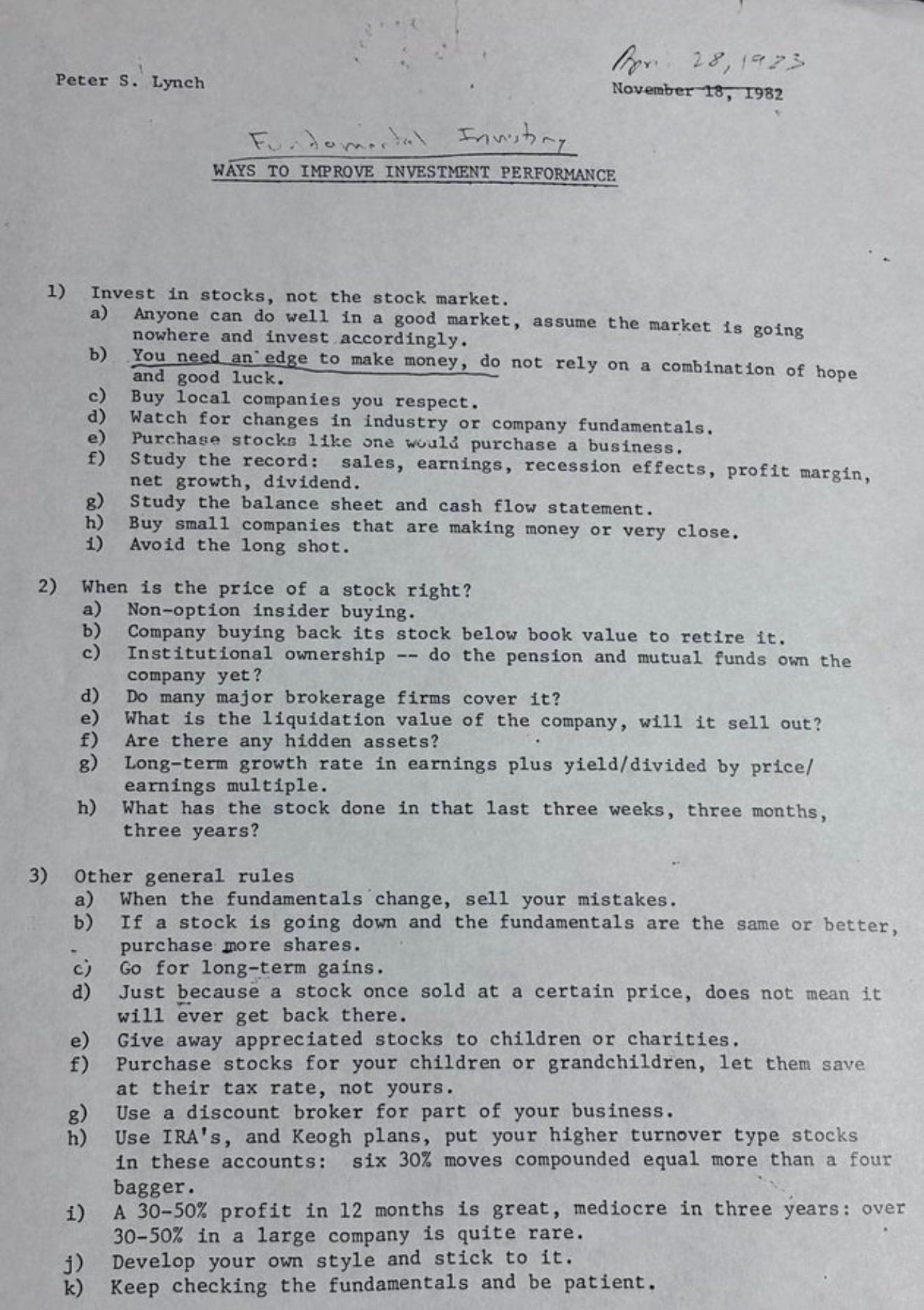
In November 1982, Peter Lynch—then a rising star at Fidelity’s Magellan Fund—typed up a one-page note titled “Ways to Improve Investment Performance.”
It was simple, direct, and written just as he was beginning the run that would turn Magellan into the most successful mutual fund of its era, compounding at 29% per year from 1977 to 1990.
This one-page document, yellowed and typewritten, still holds more practical wisdom than most modern investing books. Let’s unpack some of Lynch’s rules, why they matter, and where even seasoned investors often stumble.
The Core Philosophy: Invest in Stocks, Not the Market
Lynch starts with the reminder that “anyone can do well in a good market.” The real skill is picking individual businesses, not betting on the direction of the overall market.
He insists you need an edge—something beyond hope and luck. That edge can come from:
Knowing local companies better than Wall Street analysts.
Understanding industry shifts before they show up in earnings.
Doing the “boring” work: studying balance sheets, cash flows, and fundamentals.
Mistake many investors make:
Even professionals often default to “macro guessing”—obsessing over the Fed, interest rates, or GDP forecasts—while neglecting the grind of company-level analysis. Lynch’s point is that you win by knowing your companies cold, not by predicting recessions.
The Right Price: When to Buy
Lynch offered a checklist that still feels like a masterclass:
Is management buying their own stock?
Is the company buying back shares below book value?
Do big institutions own it yet—or is it still under the radar?
What’s the long-term growth rate, and does the price make sense against it?
Mistake many investors make:
Even skilled managers get trapped by “story stocks.” They fall in love with narratives—AI, biotech, EVs—without asking the harder question: Is the stock cheap relative to its future earnings power? Lynch knew that the market can stay excited about a story long after the fundamentals stop justifying it.
The Long Game: Patience + Compounding
One of the most striking lines from Lynch’s note:
“A 30–50% profit in 12 months is great. Mediocre in three years: over 30–50% in a large company is quite rare.”
In other words, don’t chase lottery tickets. Six 30% gains compounded can make you richer than one moonshot.
He also encouraged using tax-advantaged accounts (IRAs, Keoghs back then) for high-turnover stocks, while keeping quality compounders for the long haul.
Mistake many investors make:
The temptation to book quick gains. Selling winners too early is one of the most destructive habits—investors take a 30% win and miss out on the 300% that comes later. Lynch repeatedly said his biggest mistakes were selling too soon, not holding too long.
The Timeless Rules of Investing That Never Go Out of Style
Among his other rules worth repeating:
Don’t average down blindly. Only add if fundamentals remain intact.
Keep your style. Develop your own process instead of copying others.
Avoid the “long shot.” Most “next big things” turn into next big losses.
Be patient. Re-check fundamentals often but resist the urge to overtrade.
Why This Checklist Still Matters Today
In an age of ETFs, algorithmic trading, and endless financial noise, it’s tempting to think that Lynch’s wisdom is outdated. But read the list again and you’ll notice—nothing about it requires a Bloomberg terminal or a PhD in quant finance.
It requires curiosity, discipline, and patience. And those, as Lynch proved, never go out of style.
The irony? Many professional investors still fail on the basics. They overcomplicate, overtrade, and underestimate the power of simple compounding.
Peter Lynch’s 1982 memo is a reminder: the rules haven’t changed—only our attention spans have.
👉 What do you think? Are Lynch’s rules more relevant than ever in today’s noisy markets—or have they been eclipsed by new approaches? Drop a comment—I’d love to hear how you apply (or break) these timeless principles.