
Right About the Future. Wrong About the Risk
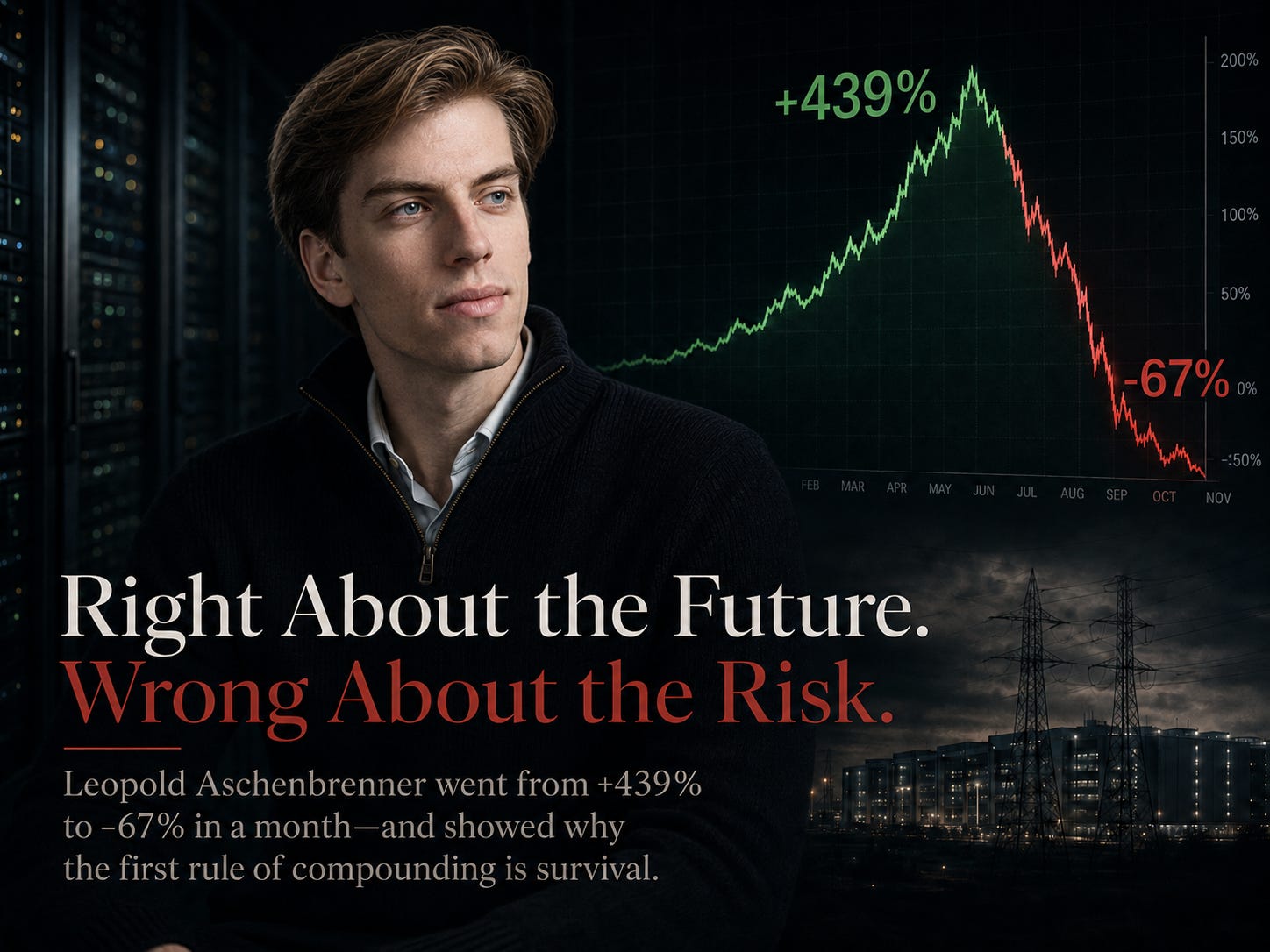
Leopold Aschenbrenner went from +439% to -67% in a month—and showed why the first rule of compounding is survival.

A few days ago, I posted something on my X account that had been bothering me:
Prediction markets, meme stocks, day trading, YOLO culture. A whole generation is learning to gamble and calling it investing.
I’ve managed money for 300+ families over 24 years. The ones who built lasting wealth were patient, disciplined, and mostly boring. That hasn’t changed.
But the more I thought about it, the more I realized there was a deeper point underneath the tweet.
The problem isn’t simply that people gamble.
People have gambled forever. And there is nothing inherently wrong with speculation, trading, prediction markets or putting a small amount of money on something because you think you know more than the market does.
The real danger is not knowing which game you’re playing.
And one of the most fascinating recent investment stories I’ve seen in a long time illustrates that point almost perfectly.
It involves a 24-year-old former OpenAI researcher named Leopold Aschenbrenner, an extraordinarily compelling thesis about artificial intelligence, one of the fastest-growing hedge funds in history—and a spectacular lesson in what happens when conviction meets leverage.
The young man who saw the future
If you don’t know Leo’s story, it’s worth spending a minute on it.
He entered Columbia at 15 and graduated valedictorian at 19. He later worked on OpenAI’s Superalignment team. In 2024, he published Situational Awareness: The Decade Ahead, an ambitious series of essays arguing that almost nobody was properly pricing in the speed and magnitude of what was coming in artificial intelligence.
His central idea was relatively straightforward.
If AI capabilities were going to improve as rapidly as he expected, the world was going to need a staggering amount of infrastructure to support it:
semiconductors, memory, data centers, electricity and all of the other physical inputs required to turn intelligence into compute.
Situational Awareness launched in 2024 and made concentrated bets on the companies likely to benefit from the AI infrastructure boom, while also betting against businesses it believed AI would disrupt. The fund attracted sophisticated investors and grew to more than $20 billion in assets in remarkably little time.
And for a while, Leo looked very quickly to have been right.
By the end of June 2026, Situational Awareness had returned approximately 439% net for the year.
Think about that for a moment.
439% and in only the first six months of 2026 alone.
Then came July.
The AI infrastructure trade reversed violently. Several of the fund’s core positions fell sharply. Other positions moved against it. Liquidity deteriorated. And because Situational Awareness had used enormous leverage to magnify its exposure, falling prices became something more dangerous than an ordinary drawdown.
They became a financing problem.
By the end of July, the fund had lost roughly 67% in a single month.
To stop the bleeding, it sold the bulk of its public-stock portfolio to Citadel in one large negotiated block, unwound most of its public equities and paid off its leverage. In his investor letter, Leo acknowledged that the fund had come closer to permanent impairment of capital than he considered acceptable.
Here’s the remarkable part.
The fund was still up roughly 80% for the year. Largely due to a private investment in Anthropic which has appreciated substantially in 2026.
The fund produced an extraordinary return—and simultaneously put itself in a position to be forced to liquidate much of the portfolio.
Icarus 2026
The easiest response to what happened is to laugh at the “AI wunderkind” who flew too close to the sun.

I think that’s the wrong lesson.
Leo may ultimately be right about AI.
Some of the businesses he owned may ultimately be worth considerably more than they are today.
None of that changes what happened.
Because there are really two questions in investing:
Are you right about the asset?
And:
Can your portfolio survive long enough for you to enjoy being right?
If I buy a stock with cash and it falls 50%, I have a painful mark-to-market loss.
But assuming my analysis hasn’t changed, I can wait for the recovery.
If I borrow heavily to own the same stock and it falls 50%, someone else may make the decision for me.
My lender doesn’t care how good my ten-year thesis is.
The margin call arrives today.
That is the big difference with and without leverage.
Leverage turns volatility into survival risk.
And once that happens, being right about the destination is no longer enough.
You have to survive the path.
One of the events the precipitated the fund’s liquidation was simultaneous margin calls from its multiple prime broker custodians/lenders including Goldman Sachs, JP Morgan and Bank of America.
Conviction is a strange virtue
Aswath Damodaran recently wrote about the Situational Awareness episode and focused on something I found particularly interesting: conviction.
We usually treat conviction as an investing virtue.
We praise investors for having the courage of their convictions. We tell stories about Buffett buying when everyone else was afraid. We celebrate the entrepreneur who bet everything on an idea nobody else believed in.
But Damodaran points out that conviction has another side. Strong conviction can lead us to concentrate more, borrow more and discount evidence that contradicts what we already believe. In that sense, conviction can amplify both skill and error.
That’s an important distinction.
You need conviction to act differently from the crowd.
But conviction is not the same thing as risk management.
In fact, the stronger your conviction becomes, the more important risk management may become—because confidence naturally tempts us to increase the size of the bet.
Markets have a nasty habit of making our highest-conviction ideas look brilliant immediately before reminding us that we don’t control the path.
That doesn’t mean don’t concentrate.
It doesn’t mean don’t take risk.
It means never confuse confidence in your analysis with certainty about the outcome.
Those are very different things.
Why younger generations are blurring the lines
This brings me back to prediction markets, meme stocks and the post that started me thinking about all of this.
Technology has blurred distinctions that used to be much easier to see.
There are at least three very different activities that we now casually call “investing.”
There is gambling: wagering money on an outcome.
There is speculation: buying something largely because you expect its price to move in your favor.
And there is investing: acquiring an interest in a productive asset because you believe the value of the cash flows that asset can produce over time exceeds the price you’re paying for it.
These aren’t moral categories. A speculator isn’t necessarily foolish. A gambler isn’t necessarily irresponsible. And an investor isn’t necessarily smart.
Very sophisticated people engage in all three.
The important thing is knowing which one you’re doing and sizing them accordingly.
Unfortunately to many “investors” today the items below increasingly seem identical.
A sports bet. A Polymarket contract. A zero-day call option. A meme stock. An S&P 500 index fund. A share of Berkshire Hathaway.
They can all be purchased from the same screen in seconds.
Same flashing P&L. Completely different economics.
And increasingly, the financial system is optimized for activity.
Apps want engagement. Exchanges want volume.
Market makers want transactions.
Everyone gets paid when we do something.
Almost nobody gets paid when we buy a good asset, put the phone down and come back ten years later.
Yet that boring behavior remains one of the most powerful wealth-creation mechanisms ever discovered.
Compounding hasn’t gotten any faster
This is what I find so interesting about the moment we’re living through.
Markets trade nearly around the clock, and our net worth can be recalculated every second.
But one important thing hasn’t accelerated:
Compounding.
A business still needs time to build customers. Though some businesses do so much faster than others - especially in the world of technology.
Capital still needs time to be accumulated and reinvested.
Earnings still need time to grow.
Reputations still need time to develop.
We can make trades faster and free.
We cannot make the underlying business compound faster simply because we are impatient.
And I suspect that mismatch—between the speed of our technology and the speed of wealth creation—is becoming increasingly important.
What 24 years of helping families build wealth has taught me
I’ve now spent more than two decades managing money for hundreds of families.
I’ve seen people create wealth in many different ways.
Some built businesses.
Some practiced medicine or law and steadily invested what they earned.
Some accumulated stock in companies where they worked.
Some were excellent investors.
Some barely cared about investing at all.
There wasn’t one formula.
But looking backward, Very little lasting wealth was created by constantly trading assets.
Most of it was created far more mundanely using the formula below:
Earn more than you spend.
Own productive assets.
Reinvest.
Let good quality businesses run by able leaders compound.
Don’t interrupt compounding unnecessarily.
And, most importantly, avoid the mistakes that take you out of the game.
That’s the part people underestimate.
We spend enormous amounts of time thinking about maximizing returns.
The more experienced I’ve become, the more I think about avoiding ruin.
Because the mathematics of compounding are asymmetric.
If you make 50% and then lose 50%, you’re not back where you started. You’re down 25%.
Lose 80%, and you need a 400% return just to get back to even.
Lose everything and the future return on that capital is zero.
The first requirement for compounding money for 30 years is therefore surprisingly simple:
You have to still have money in year 30.
Getting rich and staying rich are different.
This isn’t an argument for hiding in cash or refusing to take any risks.
Quite the opposite.
Most great fortunes involve concentration somewhere along the way.
An entrepreneur may have almost all of his net worth in one company.
A great investor may occasionally find an opportunity compelling enough to warrant an unusually large position.
Risk and wealth creation are inseparable.
But there is a difference between taking enough risk to become wealthy and taking so much risk that a temporary change in price can permanently remove you from the game. Especially when using debt or leverage.
That’s what the Situational Awareness story illustrates so well.
Leo’s thesis did not suddenly become worthless in July. According to his own investor communication, he remained optimistic about the underlying fundamentals even as the portfolio was being dismantled.
The problem wasn’t the thesis.
It was the miscalculation of nexus between the thesis, concentration, leverage, liquidity and time.
A great idea with the wrong capital structure can still be a bad investment.
A great company bought at an absurd price can still produce a poor return.
A correct long-term forecast financed with short-term money can still end in disaster.
And a brilliant investor can still construct a portfolio that doesn’t give his brilliance enough time to matter.
The lesson is simple:
Being right is only valuable if you can stay in the game long enough to collect the reward.
There will always be opportunities.
And occasionally, someone will get spectacularly rich very quickly by seeing it before everyone else.
But getting rich and staying rich are two different disciplines.
The first can require imagination, concentration and courage.
The second requires virtues that may seem less exciting:
Things like: Patience, Liquidity Management, Humility, Discipline.
And most importantly survival as a result of the above.
You can be right about the future and still be wrong about the way to manage and preprare for the risks.
Compounding only works if you survive long enough to harness it and secure it for a lifetime.