
The World’s First Trillionaire
Part I: What the First Trillionaire Reveals About Capital, Labor, and the Future of Wealth

Part I of a three-part series on the first trillionaire, the future of wealth, and the human consequences of the coming abundance explosion.
On June 12, 2026, SpaceX is set to do something no company had ever done before: turn its founder Elon Musk’s paper fortune into the world’s first confirmed nominal trillion-dollar net worth.
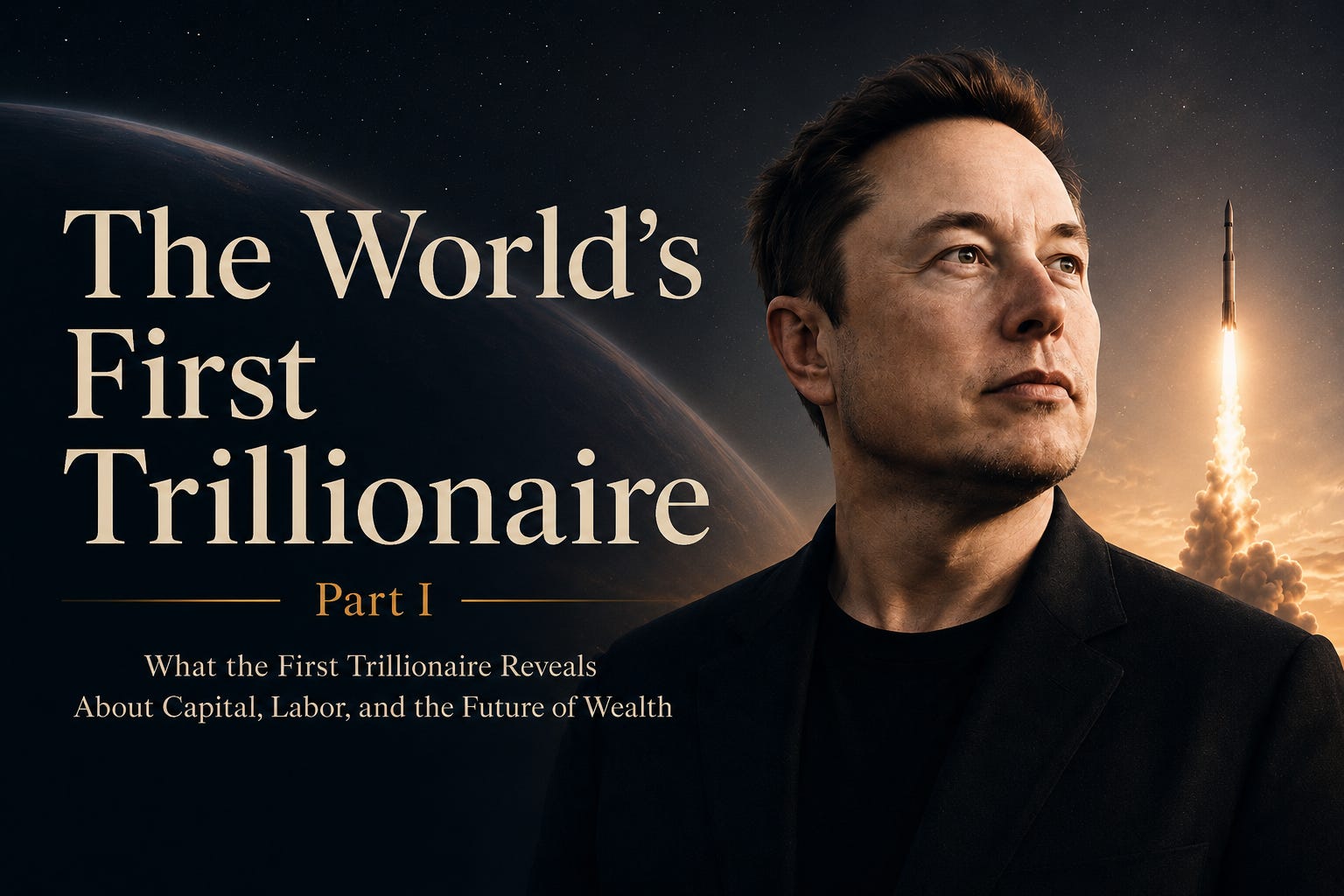
As of June 11th, 2026, the company has reportedly priced its initial public offering at $135 per share, raising $75 billion at a valuation of roughly $1.77 trillion.
If SpaceX begins trading at or above that IPO price sometime on Friday June 12th— a reasonable assumption given reports that the offering was roughly four times oversubscribed — Elon Musk will become, at least on paper, the first trillionaire in history. It will also make him over three times wealthier than the next wealthiest human on planet Earth.
Even writing that sentence feels strange.
For most of human history, even a millionaire was almost unimaginable.
A billionaire once sounded like a figure from science fiction.
Now the world is on the verge of producing its first nominal trillionaire — not a king, not a conqueror, not a state, but a founder whose wealth comes from ownership stakes in companies building rockets, satellites, electric vehicles, artificial intelligence, and communications infrastructure.
Rather than viewing this through a political lens, it is more useful to view it as a case study in how modern wealth is created.
The emergence of a trillionaire raises questions about technology, scale, ownership, and the way successful platforms can compound value across global markets.
SpaceX’s valuation may ultimately prove too high, too low, or roughly correct. Markets are imperfect forecasting machines, especially when evaluating frontier technologies. But regardless of where the stock trades in the years ahead, the broader significance remains.
The first trillionaire may be evidence that the economics of wealth creation have evolved — that in a world of software, networks, automation, satellites, and artificial intelligence, ownership of scalable systems can create value on a level and scale that was difficult to imagine in earlier eras.
That is the real story.
Not simply that Elon Musk is even richer. He has been ultra rich for quite some time already.
But that the structure of the modern economy made this scale of fortune possible.
From Millionaire to Billionaire to Trillionaire
The history of modern wealth is, in part, the history of leverage.
In the early 1800s, John Jacob Astor became America’s first great commercial fortune through fur trading, international commerce, and eventually New York real estate. His wealth was extraordinary because the economy around him was still small, local, physical, and slow.
A century later, John D. Rockefeller became the defining billionaire of the industrial age. Standard Oil was not merely a company. It was a system — refining, transportation, distribution, pricing, logistics, and scale brought together with extraordinary efficiency.
Rockefeller’s fortune was not large because he personally worked harder than everyone else. It was large because he owned one of the central economic platforms of his era.
That distinction matters because labor earns by doing while capital earns by owning and creating productivity.
But the highest form of capital ownership is not passive ownership of financial assets. It is ownership of a system that scales — a railroad, a refinery, a software platform, a search engine, an operating system, a payments network, a satellite constellation.
The more scalable the system, the greater the distance between human effort and economic reward.
The Arc of Leverage
For most of recorded history, wealth was tied to land, armies, trade routes, mines, and taxation.
The great fortunes of the pre-modern world were usually inseparable from political power. Kings commanded resources because they commanded territory. Empires accumulated wealth because they controlled people, land, and force.
Industrial capitalism changed the mechanism.
Wealth began to scale through physical infrastructure. Railroads, oil pipelines, steel mills, factories, and electrical grids multiplied human effort across geography.
A single entrepreneur could coordinate the work of thousands, then tens of thousands, then millions of people through an industrial system.
Software changed it again.
Bill Gates did not need to manufacture a new physical object for every customer in the way Carnegie needed steel mills or Rockefeller needed refineries.
Code could be written once and distributed globally. Microsoft, Google, Apple, Amazon, and Facebook became among the most valuable companies in history because software and networks have extraordinary operating leverage.
Once the system exists, each additional user can add enormous value at relatively low marginal cost.
Now we are entering a a fourth phase.
These are not simply better software businesses. They are beginning to extend digital leverage into intelligence, labor, communications, energy, and the physical world itself.
This dynamic sits at the center of the trillionaire story.
The modern economy increasingly rewards the person who owns the scalable machine, not just the person who works inside it.
That does not mean labor becomes irrelevant. It does mean that ownership has become an increasingly powerful driver of wealth creation.
The largest fortunes are typically built through equity in businesses and platforms that compound over time.
A surgeon can be highly paid.
A lawyer can be highly paid.
A banker can be highly paid.
But none of them can personally operate at planetary scale.
A platform can.
A network can.
A satellite constellation can.
An AI infrastructure layer can.
That is why the first trillionaire was more likely to come from ownership of systems than from mastery of a profession.
This idea is closely related to a theme I explored in my Compound Ideas essay, The Empires of the Future Are Empires of the Mind: the most valuable enterprises of the coming decades may look less like traditional companies and more like infrastructure layers that sit beneath entire ecosystems.
What SpaceX Actually Represents
SpaceX is often described as a rocket company. That description is increasingly inadequate.
A rocket company builds vehicles that go to space.
SpaceX is closer to a vertically integrated infrastructure company for the next economic frontier. It combines launch capability, reusable rockets, satellite manufacturing, satellite internet, government contracting, defense relevance, and potentially orbital infrastructure for communications, computation, and exploration.
This is why the valuation is so fascinating.
If SpaceX were merely a launch provider, $1.77 trillion would be difficult to justify. The global launch market alone cannot support anything close to that.
If SpaceX were simply a better aerospace contractor with reusable rockets, the valuation would appear aggressive.
But the market is not valuing SpaceX as a rocket company.
It is valuing SpaceX as a platform company.
Starlink is a global satellite internet network - not just another telecom product. It is a communications layer that does not depend on terrestrial cables, cell towers, or local infrastructure.
In remote regions, disaster zones, military theaters, shipping lanes, aircraft, and underserved markets, that matters.
Launch capability also changes the equation. If access to orbit becomes dramatically cheaper and more reliable, then entirely new industries become plausible: orbital manufacturing, space-based sensors, defense networks, lunar logistics, and perhaps one day energy or computation in space.
Some of this may prove overly optimistic. Markets have a long history of recognizing long-term possibilities before the underlying economics are fully mature.
But some possibilities become infrastructure.
Railroads were once speculative. So were canals, electricity, telephony, aviation, semiconductors, software, and the internet. Many individual companies failed. The underlying infrastructure still changed civilization.
That is the paradox of SpaceX.
The valuation may be too ambitious right now, and the company may still be historically important.
Those two statements can both be true.
Breakthrough, Expectations, and Scale
The question is how much of its future the market potential is already recognizing today.
A company can be strategically important and still be priced ahead of near-term fundamentals. It can dominate an emerging industry and still require many years of execution to grow into the expectations embedded in the price. It can build the future and still challenge investors to think carefully about starting valuation.
That is not a criticism of SpaceX. It is the nature of investing in frontier infrastructure.
The market is doing what markets often do with extraordinary companies: taking a large potential future and translating it into present value.
History suggests that transformative technologies often go through periods where expectations move faster than near-term results. The internet was real in 1999. Railroads were real in the nineteenth century. Fiber-optic networks were real. Electric vehicles were real. Artificial intelligence is real.
The challenge for investors is separating the quality of the company from the price paid for it.
SpaceX now sits directly inside that tension. It may become the most important company of the twenty-first century. Or it may become a painful lesson for investors if the AI and space themed sectors are too over heated and is destined to cool at least for a time.
That is what makes the Spacex IPO today such a powerful symbol of the current moment.
The Capital Question
The larger issue is not Musk and his personal wealth. It is the changing dominance of capital.
One of the most consistent patterns in economic history is that ownership of productive assets tends to compound over time. Whether those assets are factories, railroads, software platforms, intellectual property, or satellite networks, ownership creates leverage.
The biggest fortunes are increasingly attached to ownership, not wages. The people who own scalable systems can see their wealth compound at rates unavailable to people who merely sell their time, even highly paid time.
This is not just a story about multi billionaires or the worlds first trillionaire.
It is a story about the architecture of capitalism.
If AI makes knowledge work cheaper, if robotics make physical work more productive, if software automates coordination, and if networks distribute products globally at near-zero marginal cost, then ownership of the underlying systems becomes increasingly valuable.
The economy may produce more total wealth than ever while disproportionately rewarding those who own platforms, networks, intellectual property, energy infrastructure, and other scalable assets.
This is why the first trillionaire matters.
He is not necessarily an anomaly.
He may be the first visible example of a broader tectonic shift toward increasingly scalable forms of value creation.
From Companies to Empires
The comparison to Rockefeller is unavoidable.
Rockefeller built Standard Oil by controlling key parts of the oil economy. Musk’s collection of companies touches several of the key platforms of the emerging economy: electric vehicles, batteries, launch capacity, satellite communications, artificial intelligence, and potentially robotics.
There are important differences.
Rockefeller’s dominance was rooted in a single industry. Musk’s influence spans multiple technological domains that increasingly intersect with one another.
A private company operating a global satellite communications network is something previous generations could not imagine.
A founder whose companies touch transportation, defense, AI, energy, and space occupies a unique position in the modern economy.
Technological progress is increasingly being driven by private organizations that resemble global infrastructure platforms wielding tremendous power and influence - many that may be much harder to understand, govern and regulate.
As I argued in The Empires of the Future Are Empires of the Mind, the defining enterprises of the coming century may be those that control foundational layers of energy, computation, communications, mobility, and intelligence. SpaceX fits naturally into that framework.
Churchill understood the difference between empires that liberate and empires that enslave. That distinction matters here too. The most important platforms of the future will not merely create economic value. They will shape what people can access, how they communicate, what they trust, and how societies organize themselves.
That is why SpaceX is more than a valuation story. It belongs to a broader category of enterprises that may become so foundational that they begin to resemble infrastructure for civilization itself.
What the Trillionaire Era Means
The first trillionaire changes the psychological ceiling.
Once something happens once, it becomes thinkable. Once it becomes thinkable, capital begins to organize around the possibility that it will happen again.
The next trillionaire may come from AI. Or energy. Or robotics. Or biotechnology.
Or a company that owns the interface through which billions of people access machine intelligence. Or from an asset owner positioned at the bottleneck of compute, power, land, chips, data, or distribution.
Extreme wealth in the coming era will likely accrue to those who control the scarce inputs to abundant production.
If intelligence becomes cheaper, compute becomes more valuable. If software becomes abundant, distribution becomes valuable. If content becomes infinite, trust becomes valuable. If digital goods become frictionless, physical scarcity becomes valuable.
That is one if the key investment implications.
It is also a useful lens for understanding where value may accumulate in the future.
The Real Meaning of the First Trillionaire
It is tempting to treat the first trillionaire as a spectacle.
It is more useful to treat him as a signal.
A signal that capital markets are willing to value frontier infrastructure at almost unimaginable levels.
A signal that visionary founders can create companies that reshape entire industries.
A signal that ownership of scalable systems can convert technological progress into private wealth at extraordinary scale.
And perhaps a signal that investors are increasingly willing to place large bets on long-term technological futures.
The first trillionaire does not prove that capitalism is broken though it may be a sign of widening inequality. Nor does it prove that every valuation attached to transformative technology is justified.
It does suggest that the scale of modern value creation has changed.
A millionaire once represented personal success.
A billionaire represented industrial dominance.
A trillionaire represents something else: ownership of platforms so large, so leveraged, and so central to the future that the market is willing to capitalize decades of possibility into one human balance sheet.
That should capture our attention.
Most of all, it should force us to update our mental models.
That is where Part II begins — because the first trillionaire is not the end of the story. It is the opening signal of a much larger question: what happens to scarcity, purpose, work, and meaning when the systems that create wealth become more powerful than anything human beings have built before?
Part II of my trillionaire series will explore what happens when abundance itself becomes the problem while Part III will ask what cheap intelligence means for business, investing, and the future of human work. Stay tuned!
If you liked this article please support my work by subscribing and sharing it with others.
Pretty unbelievable.
This world need more explantion
“In light of the concerns outlined above, we respectfully ask you to address the following questions: • Did Nasdaq conduct a formal analysis of the impact of the fast-entry rule on investors in Nasdaq-100 tracking funds before enacting the change? If so, we request that this analysis be disclosed publicly. If not, we ask that you explain why a rule change affecting over $1.4 trillion in investor assets was adopted without such an analysis”
https://www.oregon.gov/treasury/Documents/Site-Documentation/Unlinked/Letter_Nasdaq_20260626.pdf?utm_medium=email&utm_source=govdelivery